







Most renovators get it backwards.
They fall in love with the property. The bones. The potential. That vision of what it could become.
But here’s the brutal truth: Your vision means nothing if the market won’t support it.
I’ve watched too many passionate renovators pour their hearts (and their wallets) into properties in suburbs that looked perfect on Instagram but had been stagnant for years. Meanwhile, the “unsexy” suburbs nobody talks about are quietly delivering consistent returns.
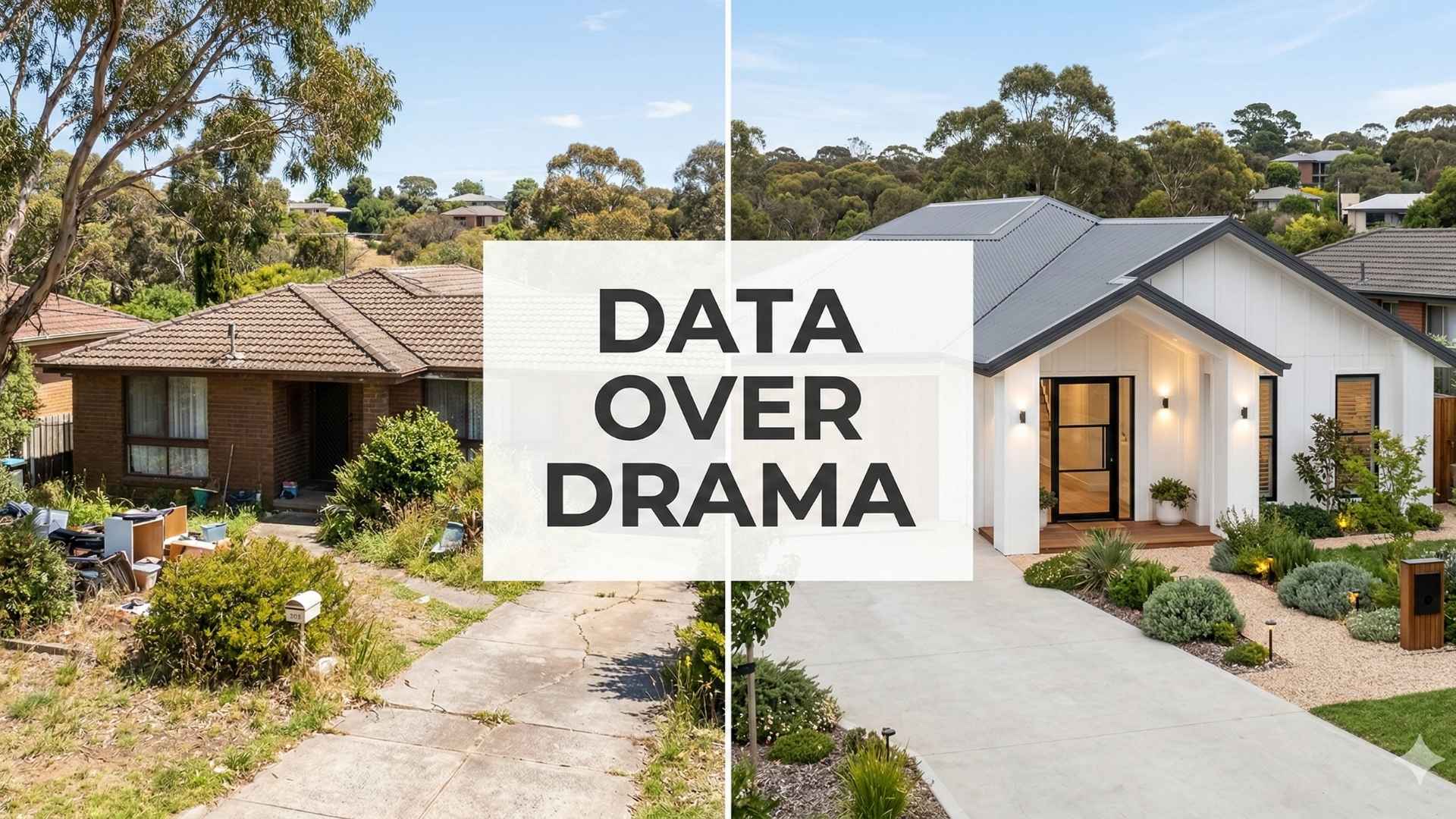
The difference isn’t talent or creativity. It is the discipline to make data-driven renovation decisions.
What are Data-Driven Renovation Decisions?
Data-driven renovation decisions are choices based on historical market performance, suburb growth trends, and strict feasibility formulas rather than emotional attachment to a property’s aesthetics.
At The School of Renovating, we teach that success starts before you ever set foot in a property. By focusing on the numbers first, you ensure you aren’t just buying a house you’re securing a profit margin that meets our 50K Profit Rule.
If you are tired of guessing, this guide will show you how to swap “hope” for “certainty.”
Which Data Drives Profitable Renovation Decisions?
Smart renovators don’t just “look” at a suburb; they dig deep into the history.
One of my absolute favourite tools at The School of Renovating is the Suburb Stats Report. Not because it’s exciting (it isn’t). But because it tells you the truth your emotions won’t.
Here is what separates the profitable business operators from the dreamers:
1. Market Timing Intelligence
You need to see exactly how much your suburb’s median price has moved over the past 10 years. This isn’t curiosity; it’s survival.
Boom-bust patterns tell you when to hold and when to fold.
- Avoid the Peak: Don’t buy when a suburb has just finished a massive run-up.
- Spot the Trend: Identify areas just starting their upward cycle before the crowd arrives.
Key Takeaway: By analyzing historical cycles, you stop gambling and start strategizing. Learn more about reading these cycles in our interview with Property Market Analyst John Lindeman.
2. Renovation ROI Reality Check
Historical data indicates whether a suburb actually supports the price growth you need to make a profit. Full stop.
Some areas appear promising on paper but have remained stagnant for years. The data doesn’t lie about this. Others are quietly building momentum while everyone is distracted by the “hot” suburbs influencers are hyping.
The difference? One makes you money. The other makes you a statistic.
To ensure you fall into the first group, you must run a strict Renovation Feasibility Analysis before making an offer.
3. Investment-Grade Confidence
When you are ready to secure finance or bring in joint venture partners, you cannot present a hunch.
You must present 10 years of market evidence that supports your projections. This is what separates hobby renovators from professionals.
Data turns your pitch from “I think this will work” to “Here is why this will work.”
Banks and investors don’t care about your vision; they care about the safety of their money. Give them the numbers.
Struggling to get approved? Read our guide on How to Secure Renovation Finance After 50.
Why “Boring” Suburbs Often Outperform “Sexy” Ones
Here is the biggest mistake most people make with suburb selection:
They assume that if a suburb looks good on social media, it must be a good investment. The reality is often the opposite. The suburbs that appear unappealing on Instagram often exhibit the most consistent growth patterns in the data.
You are not looking for sexy. You are looking for profitable.
The Media Lag Effect
By the time a suburb is trending on property forums and getting featured in lifestyle magazines, the smart money has already moved on. They bought in three years ago when the data was whispering what everyone is now shouting.
What is the Media Lag Effect?
The Media Lag Effect occurs when a suburb’s popularity peaks after its rapid capital growth phase has ended. Data-driven renovators buy before the hype; emotional buyers buy during it.
Trendy vs. Profitable: Knowing the Difference
To build a High-Equity, High-Cash Flow Portfolio, you must learn to spot the difference:
- Trendy Suburbs: High entry price, saturated market, lower yields, “emotional” competition.
- Profitable Suburbs: Affordable entry price, steady historical growth, high rental demand, “data-backed” potential.
Don’t get caught in the Renovation Comfort Zone Trap. Comfort feels safe, but it rarely builds wealth.
Conclusion: How to Guarantee Renovation Profit
Ultimately, smart renovation decisions are data-driven decisions.
Your creativity matters. Your eye for design matters. Your execution matters. But none of it matters if you are renovating in the wrong suburb, at the wrong time, with the wrong price expectations.
Stop letting emotion drive your biggest financial decisions.
Start with the data. Understand the market. Know your timing. Then and only then fall in love with the property. Because here is the truth nobody wants to hear:
“The most beautiful renovation in a stagnant suburb is still a financial mistake.” Bernadette Janson
The data tells you where the opportunity is. Your skill captures it. Your profit proves it. That is how you build wealth through renovation not by chasing trends, but by following evidence.
Ready to Master the Data?
If you want to stop guessing and start profiting, join our Free Masterclass: The Profitable Renovator.
We will walk you through the exact system we use to find high-growth suburbs and manufacture a $50K+ profit on every project.