







You’ve found the perfect property. You’ve secured the finance. You’re ready to start creating value. But there’s a gate between you and your profit: strata approval.
And here’s the brutal truth most renovators learn too late: every week you wait for approval is a week you’re hemorrhaging money.
This isn’t about being impatient. It’s about understanding the financial reality of renovation: holding costs don’t pause while you wait for committee meetings.
The Cost of Delay
At The School of Renovating, we estimate that for a standard project, waiting for strata approval silently erodes profit by $2,000+ per week in interest, council rates, and levies. That means a 6-week delay could wipe out $12,000 of your bottom line before you even pick up a hammer.
Why “Winging It” Destroys Profits
Many beginners believe they can sort out approvals after settlement. This is a mistake.
To secure a $50K-$100K profit, you cannot afford to wait for the next quarterly strata meeting. You need a strategy that begins the moment you inspect the property.
Learn more about protecting your margins in our guide on The $50K Profit Rule and avoiding the Renovation Comfort Zone Trap.
Renovation Holding Costs: The Mathematics of Procrastination
Let’s look at the hard numbers. We call this the mathematics of procrastination.
On a typical cosmetic renovation project, your holding costs mortgage interest, council rates, insurance, and strata fees average around $2,000 per week.
If your strata approval renovation process takes 6 weeks instead of 3 because of poor preparation, you haven’t just lost time. You’ve burned cash.
The Cost of “Winging It”
- Weekly Holding Cost: ~$2,000
- Delay: 3 Extra Weeks
- Lost Profit: $6,000
That is $6,000 straight out of your profit allocation. Your target $100,000 profit just became $94,000 before you’ve even started.
If anything else goes wrong, you have no financial buffer left. This is the difference between profitable renovators who plan for speed and those who “wing it.” One group walks away with full profit; the other wonders why their numbers never match their projections.
The Velocity Strategy: Speed with Accuracy
When strata or council permission sits between you and starting work, your priority isn’t perfection. It is velocity with accuracy.
Definition: Velocity with Accuracy
This does not mean rushing or cutting corners. It means moving with strategic speed preparing every detail before settlement because every delay costs you real money in holding costs.
Here is the Pre-Settlement Protocol we teach to ensure you hit the ground running:
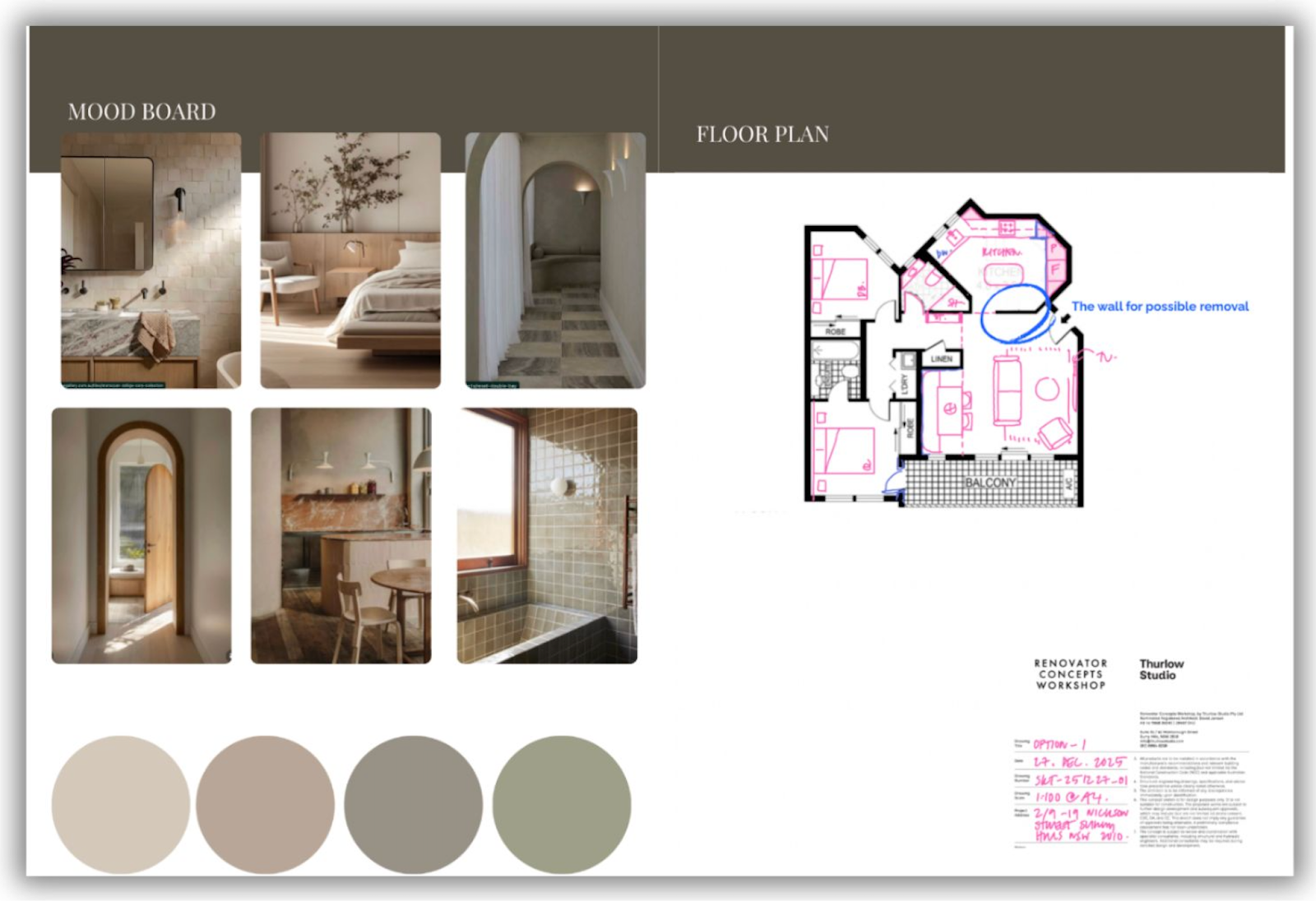
- Architect Ready: Your architect is ready to move the moment you settle. They aren’t “thinking about concepts” they have a timeline and a process locked in.
- Materials Pre-Selected: You aren’t browsing tile shops after you buy. You have pre-selected materials so your builder can price the job immediately. You know what you’re installing, and you know what it costs.
- Documentation Complete: You understand exactly what documentation strata needs. You aren’t guessing; you have researched the bylaws and know the specific requirements for your building.
- Legal Support Aligned: Your lawyer is briefed and ready before you need them. Drafting strata bylaws takes time, and you cannot afford to discover that fact three weeks into your holding period.
- By following this renovation planning approach, you turn “waiting time” into “profit protection.”
The Strata Reality: Control What You Can
Here is the thing about strata committees they operate on their own timeline. But you have more control than you think.
When you submit a complete, professional application with all required documentation, you eliminate the back-and-forth that stretches the strata approval timeline from 3 weeks to 8 weeks. You make it easy for them to say “yes.”
Pro Tip: The “EGM” Strategy
Don’t wait for the quarterly meeting. A well-prepared renovator can often convince the committee to call an Extraordinary General Meeting (EGM) to review the application immediately.
- The Result: You control the timeline.
*The Benefit: You stop paying holding costs on an empty property.
Every day you wait for that submission is a day you pay holding costs with no return. This is why preparation matters. This is why having everything organized before you settle is the difference between a hobbyist and a profitable renovator.
Case Study: The “Class Project” Standard
In renovation, planning prevents profit erosion.
We do not plan for perfection; we plan for speed.
When we work at pace on our Class Projects, it isn’t because we are cutting corners. It is because we have done this enough times to know exactly what delays cost.
For every project, before we even settle, we aim to have the “Pre-Start Big 3” complete:
- Concept Finalized: Our architect has the layout locked in.
- Scopes of Work Done: We have detailed scopes of work ready for trades.
- Selections Made: Tiles, taps, and finishes are chosen to avoid lead-time delays.
The Reality Check
Even with this preparation, we know there is still work to do: final budgets, detailed programming, and strata bylaw draftingThe critical difference? We knew we needed these things before we started. We didn’t discover them three weeks in.
This foresight is the only way to protect your profit margin in a strata renovation.
The Choice: Profit vs. Procrastination
You have a choice in every renovation project.
- Move with strategic speed: Fully prepared, documentation ready, team assembled.
- Wing it: Discover requirements as you go, and watch your profit evaporate at $2,000 per week.
The Renovator’s Ledger
| The “Winger” | The “Strategic Planner” |
| Pays holding costs to “figure it out” | Pays holding costs to build |
| Discovers delays after settlement | Solves delays before settlement |
| Outcome: Profit Erosion | |Outcome: Velocity with Accuracy.|
Most renovators choose the second option without realizing they’re choosing at all. They think they are “taking their time to get it right.”
What they are actually doing is paying thousands of dollars for the privilege of figuring things out slowly.
The brilliant renovators? They plan for velocity. They understand that speed and quality aren’t opposites when you’ve prepared properly. They know exactly what approvals they need, exactly what documentation is required, and exactly who to call to make it happen.
And they keep their full profit allocation because they’re not bleeding holding costs while they figure it out.
Conclusion: Your Approval Timeline Starts Now
If you are planning a renovation that requires strata approval or council permission, your timeline doesn’t start when you settle. It starts right now.
The work you do before you buy researching requirements, assembling your team, and understanding the process determines the outcome.
It determines whether you pay $6,000 in unnecessary holding costs, or whether you move at speed, get approval in the shortest possible timeframe, and keep that money where it belongs: in your profit allocation.
The Golden Rule
“In renovation, planning prevents profit erosion.”This is what separates profitable renovators from those who wonder why their projects never deliver the returns they projected. It is not luck. It is not market conditions. It is preparation.
Every day you wait costs you money you’ll never get back.
Stop Guessing. Start Profiting.
Don’t let the approval process remain a mystery.
- Fast-Track Your Success: Join the Wonder Women Renovators program to get the templates, checklists, and support you need.
- See It In Action: Check our Events Page for upcoming workshops where we break down live deals.
- Start Your Journey: Book a Discovery Call to map out your profit potential.